Texas Halts New H-1B Hiring at Public Universities & State Agencies
The Texas state government has ordered public universities and state agencies to pause filing new H-1B petitions. Current visa holders keep their status, but new hiring of foreign professionals at taxpayer-funded institutions is on hold until at least mid-2027.
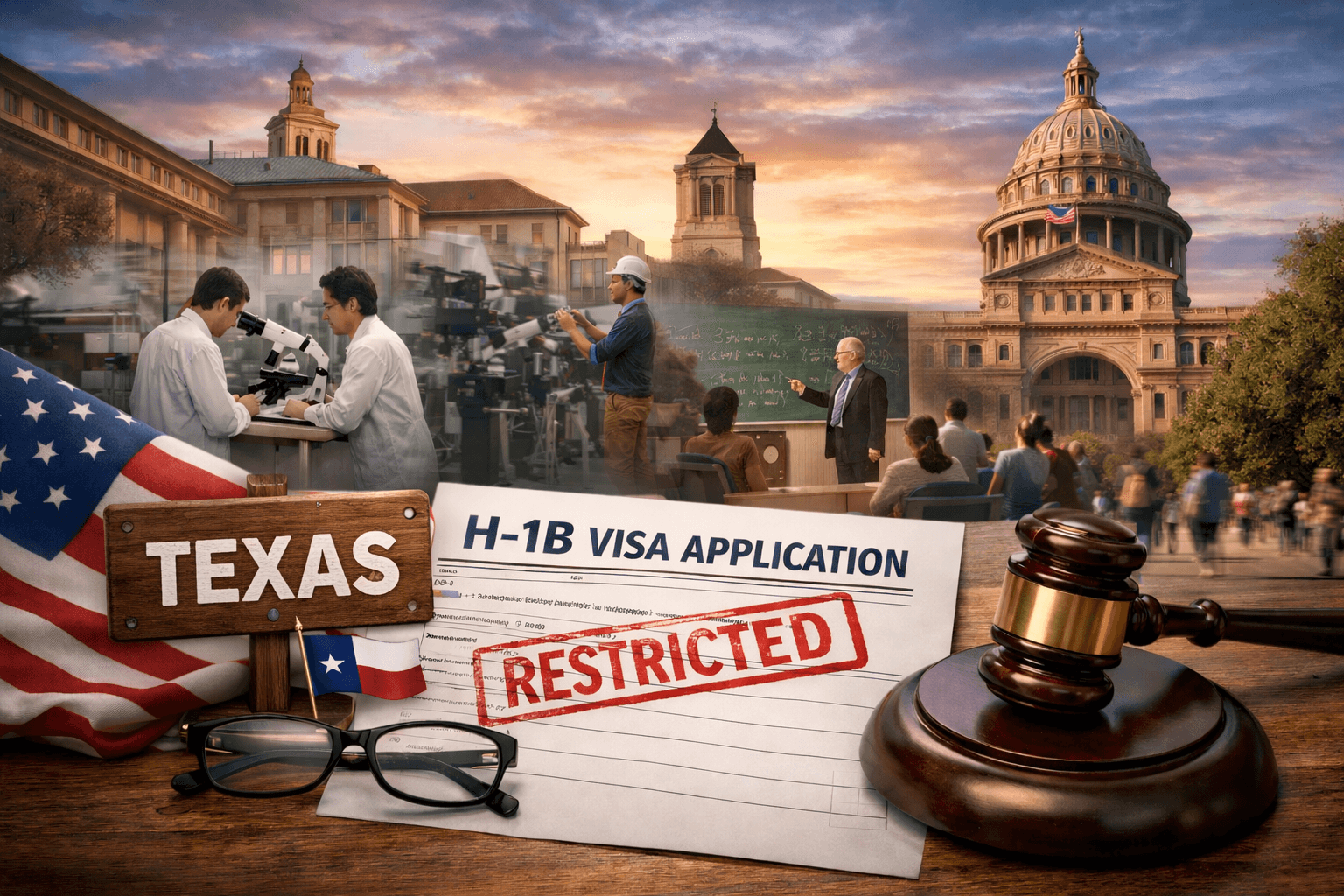
This is a state-level hiring restriction, not a change to federal H-1B law. Private companies in Texas may continue filing H-1B petitions as usual.
Quick Facts
- Applies to: public universities and state agencies in Texas
- Action: stop initiating new H-1B petitions; special approval required for exceptions
- Timeline: restriction runs through mid-2027 unless modified
- Existing staff: current H-1B workers stay employed; pending petitions continue
- Scope: private-sector employers are not impacted
What the order does
Restrictions
No new H-1B petitions may be initiated by public universities or state agencies without special clearance.
Exceptions require explicit, case-by-case permission from state leadership.
Order remains in place until mid-2027, when it will be reviewed.
Still allowed
Existing H-1B employees keep working; current approvals and pending cases are not canceled.
Private employers in Texas continue filing H-1B petitions normally.
Renewals and amendments for current public-sector H-1Bs may proceed if already in process.
Who is affected (and who is not)
Most impacted roles
- Professors and lecturers
- Academic researchers and lab staff
- Medical specialists in teaching hospitals
- Engineers and IT staff on university/state projects
- Niche technical roles at public institutions
Not affected
- Private-sector employers (tech, consulting, finance, healthcare)
- Cap-exempt nonprofits outside state control
- Existing H-1B holders already employed by public entities
Why this matters
H-1B workers make up well under 1% of staff at most universities and hospitals, but they often hold hard-to-fill roles. The pause is small in headcount yet high in impact: losing a single principal investigator, specialist surgeon, or systems engineer can stall research, patient care, or critical infrastructure projects.
What to watch next
- State guidance on how “special permission” requests will be reviewed and approved.
- Any litigation challenging the pause on grounds of federal preemption or academic freedom.
- Renewal and extension outcomes for current public-sector H-1Bs as 2026–2027 cycles approach.
- Whether other states copy or reject similar measures.